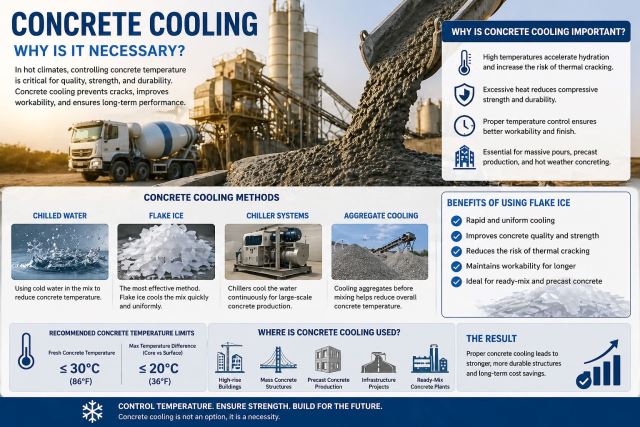
Why Is Concrete Cooling Necessary? Its Critical Role in Hot Climates
Concrete production may seem simple, but it requires precise temperature control. Especially in hot climates, internal concrete temperature becomes a serious engineering challenge. This is where concrete cooling systems play a vital role.
Why Is Concrete Temperature Important?
Concrete generates heat during the hydration process (reaction between water and cement). If not controlled:
- Cracks may occur
- Strength may decrease
- Long-term durability is compromised
When temperatures exceed 30°C (86°F), risks increase significantly.
How Is Concrete Cooling Achieved?
Common methods include:
- Chilled water
- Flake ice addition
- Chiller systems
- Aggregate cooling
Among these, flake ice is the most effective and fastest solution.
Advantages of Using Ice
Flake ice melts directly into the mix, providing:
- Rapid temperature reduction
- Homogeneous cooling
- Improved concrete quality
Concrete cooling is not optional in hot climates it is essential. Choosing the right system ensures structural integrity and long-term performance.